
Your first long trip in retirement: Plan breaks, arrival and return
Your suitcase may be ready, but a relaxed journey starts before you reach your destination. This guide helps you divide your first long trip after retirement into manageable stages: where to stop, how to reach your accommodation on arrival and how much flexibility to leave for the return. An illustrative example compares two ways of visiting family. You will also find questions about mobility and budget, plus a practical checklist. If you have statutory health insurance in Germany and are travelling abroad, ask your own health insurer which proof of cover is appropriate and what protection it actually provides.
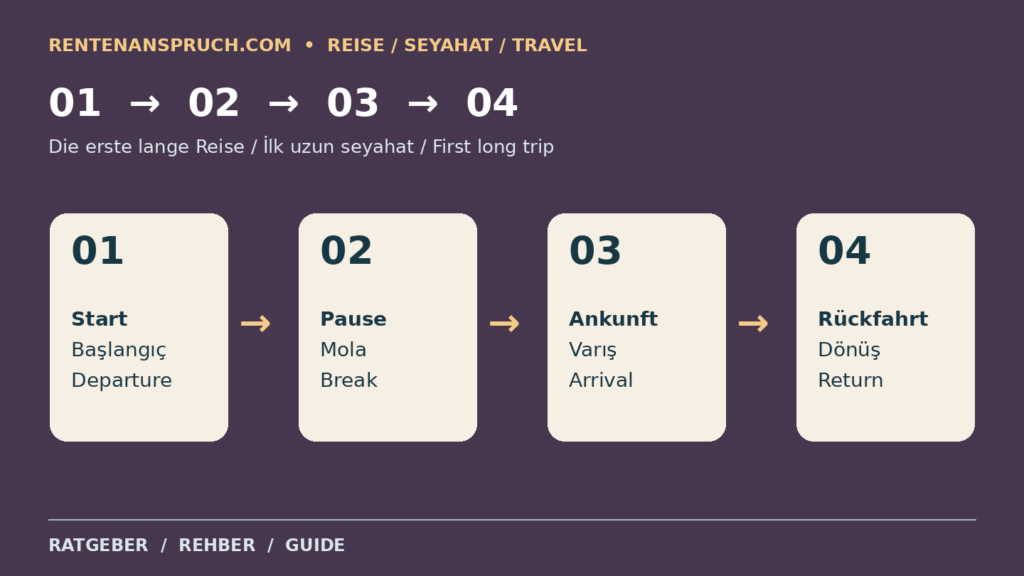
On a free morning early in retirement, a map, two transport ideas and a family invitation are spread across the kitchen table. The journey can take longer than it once did. But do you really want to cover the whole distance in one day? This scene and the planning exercises below are editorial suggestions, not fixed travel rules.
Divide the journey into comfortable stages
Start with what matters to you on the way: a seat, an accessible toilet, room for a walking aid or the freedom to choose when to stop. Then compare driving, rail and other connections not only by price, but also by changes, walking distances and the time needed to reach your accommodation.
Write out the outward and return journeys separately. Mark possible breaks and an alternative if a connection does not suit you. Ask the provider about current departure times, help getting on and off, and conditions for luggage or mobility aids. A break is an option you give yourself, not an appointment you must keep at all costs.
Make arrival easier
Picture the final steps: from the car park or platform to the entrance, and then to your room. Ask the accommodation about the approach, lift, stairs and actual distance to the entrance. Check when you can arrive and whom to contact if you are delayed.
If family are collecting you, agree on a specific meeting point and a second way to get in touch. You might leave the first evening deliberately open: unpack, eat and decide about the next day afterwards. If you are exploring a place where you might eventually live, try some ordinary local journeys too. A visit alone does not settle a decision to move.
Worked example: Compare two routes on one page
Illustrative planning example: A couple considering a family visit compare a direct train journey with a drive that includes an overnight stop. On one sheet they list the fare or vehicle costs, accommodation and the journey from their arrival point to the family. These options are invented; actual prices and connections need checking.
- Each person writes down roughly how long they would like to sit and what support they need.
- They ask about the train connection and access to accommodation, and identify a suitable stop for the drive.
- They add meals and a budget buffer, then compare the return journey too.
- Only then do they choose the option that suits both people and their budget.
The direct train may be simpler; an overnight stop may allow more flexibility. The decision depends on real availability and personal preferences.
Prepare the return and your documents
Think about getting home before departure, while leaving room for changes where possible. Compare ticket change conditions and decide whom you can contact if plans shift. Note how you will travel home from the final station or car park, too.
For people with statutory health insurance in Germany, the German Federal Ministry of Health recommends discussing proof of cover and its scope with their own health insurer before a holiday abroad. Germany’s liaison body for health insurance abroad, DVKA, provides country leaflets. Ask your insurer whether a European Health Insurance Card or a separate certificate is appropriate and what it covers. A certificate does not mean every treatment is covered.
- Check connections, potential stops and access to your accommodation.
- Keep contacts, bookings and return information within easy reach.
- Compare budgets including meals, transfers and a reserve.
- For travel abroad, discuss proof of insurance and open questions with your insurer.
Must I book the return journey in advance?
That is a personal choice. Compare the price and change conditions with your wish for flexibility. Even without a confirmed booking, check possible connections and whether you could extend your stay if plans change.
What if my travel companion needs more breaks than I do?
Discuss your needs before booking and take account of the person who prefers shorter stretches. Consider together whether an overnight stop or a different connection would work better for everyone.
Official source: Official guide →
26.11.2026
Share
Document Preparation Check
Three short choices. Request your preparation list by email. No identity document, insurance number or medical information required.